AS promised I am back with the last part of my tobacco series. It is about industrialisation of tobacco and how it became such a behemoth.
The Machine That Changed Everything
For the first two centuries of American history, the cigarette itself was practically an afterthought, viewed with suspicion as a marginal and lower-class. Most Americans who consumed tobacco did so by chewing it, sniffing it as powdered snuff, or smoking large, heavy cigars. Cigarettes were wildly inefficient and expensive to produce, as every single one had to be meticulously rolled by hand by skilled workers.
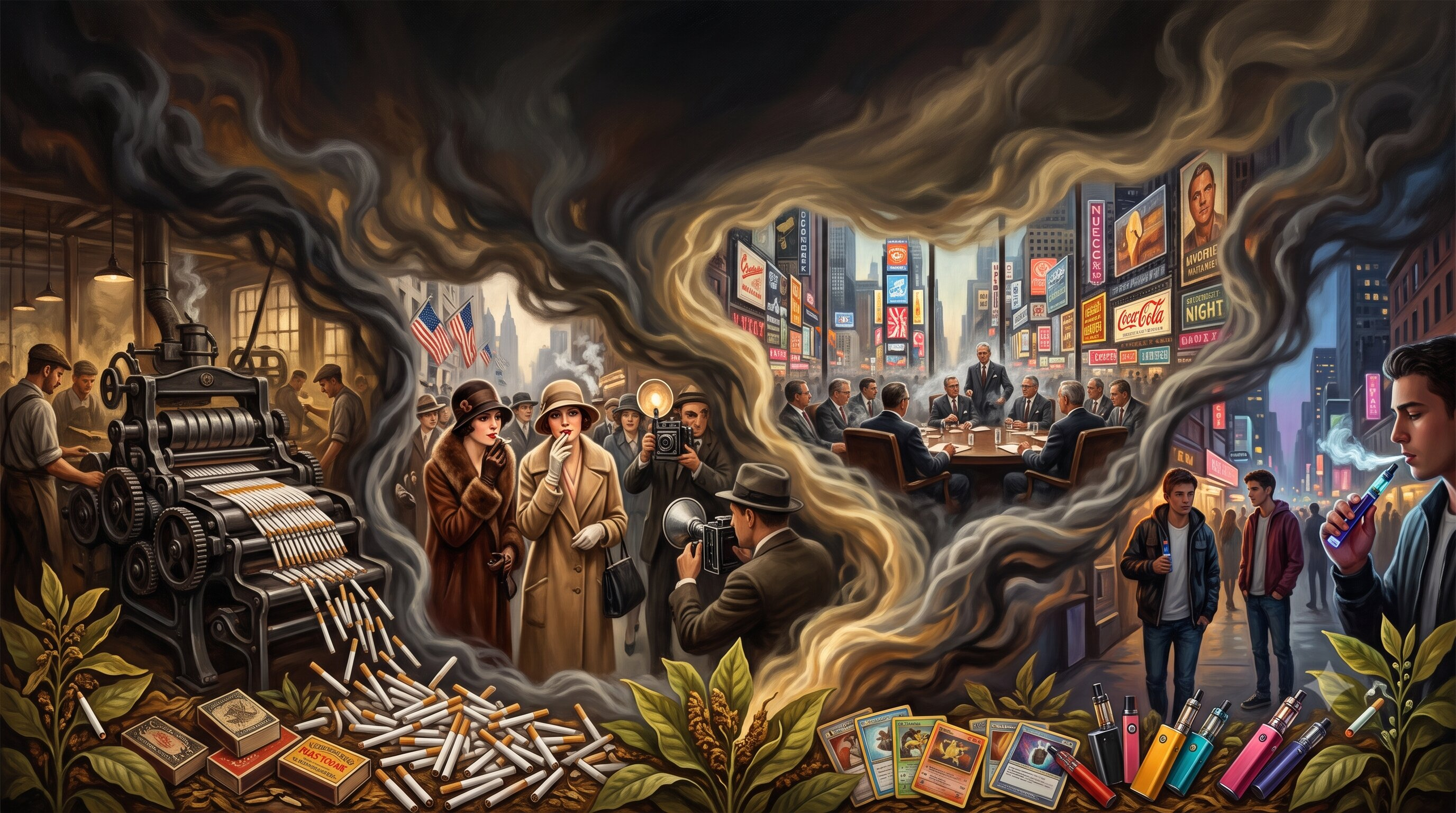
The entire trajectory of global human health changed irreversibly in 1880 with the invention of a heavy, clattering piece of machinery: the Bonsack rolling machine. Invented by a young mechanic named James Albert Bonsack, this marvel utilized a continuous feeding loop of paper to drop a precise amount of shredded tobacco into a tube, paste it shut with starch, and slice it into perfectly uniform lengths. While a highly skilled human worker could roll perhaps 200 cigarettes in an exhausting hour, the Bonsack machine effortlessly churned out 120,000 cigarettes in a single day, doing the work of nearly fifty men.
An ambitious, ruthlessly visionary businessman named James Buchanan Duke immediately saw the terrifying potential. Duke secured the exclusive rights to the Bonsack machine for his company, drastically slashing his production costs to a fraction of a cent per cigarette. However, this technological triumph created a massive problem: his factory was suddenly producing millions more cigarettes than the American public actually wanted to smoke. To survive, Duke couldn’t just fulfill an existing demand; he had to manufacture new desire out of thin air.
The Invention of Lifestyle Marketing and PR
To move his massive, growing mountains of inventory, Duke and his American Tobacco Company practically invented the modern advertising and consumer loyalty industries. To incentivize repeat purchases, he introduced beautiful, full-color collectible trading cards inside every pack featuring famous baseball players, vaudeville actresses, and historical figures.
Children would literally beg their fathers to buy specific brands just to complete their collections. Duke created the first branded matchbooks and launched elaborate, nationwide loyalty premium catalogs where smokers could redeem paper coupons for straight razors, mantle clocks, parlor furniture, and fine clothing. He wasn’t just selling roasted tobacco leaves anymore; he was selling an entire aspirational lifestyle ecosystem.
The final catalyst that cemented the cigarette’s absolute global dominance was the outbreak of World War I. Military leadership, including General John J. Pershing, publicly declared that tobacco was as indispensable to the war effort as daily food rations or ammunition.
The American Tobacco Company happily obliged military contracts, and millions of cheap, machine-rolled cigarettes were distributed freely to frightened young soldiers fighting in the muddy trenches of Europe. The cigarette was perfectly suited for trench warfare because it was quick to smoke, easy to carry in a breast pocket, and provided a brief, intense chemical hit of calming nicotine amidst artillery fire. When the Great War ended, an entire generation of victorious young men returned home completely, hopelessly addicted to nicotine.
By the dawn of the 1920s, Big Tobacco faced a frustrating glass ceiling: society still viewed women smoking as a strict, unforgivable taboo associated with moral looseness or rebellion. To double their consumer base, the American Tobacco Company hired Edward Bernays, a nephew of Sigmund Freud who is widely considered the founding father of modern public relations.
In 1929, Bernays orchestrated a “created event” during the heavily publicized New York Easter Parade by secretly hiring fashionable, upper-class women to boldly light up Lucky Strike cigarettes in front of pre-positioned photographers. He branded the cigarettes to the press as “Torches of Freedom,” explicitly linking the addictive chemical to the burgeoning women’s liberation movement. The gender taboo shattered almost overnight. The industry then aggressively marketed cigarettes as a glamorous weight-loss tool, using the slogan, “++Reach for a Lucky instead of a sweet++”.
This strategy of ruthless demographic exploitation became permanent. Decades later, when the federal government banned cigarette advertisements from television and radio in 1971, the industry flooded inner-city Black neighborhoods with massive, unavoidable billboard campaigns. They specifically pushed menthol brands and poured strategic funding into civil rights organizations like the NAACP, intending to weave menthol cigarettes inextricably into the fabric of Black cultural identity, a manufactured stereotype that persists with devastating health consequences today. Knowing the vast majority of lifelong smokers begin their habit before age 18, they also deployed friendly cartoon mascots like Joe Camel, who in the 1990s was recognized by more American preschoolers than Mickey Mouse.
The Disinformation Playbook
The most profound existential threat to the tobacco empire arrived in the early 1950s when rigorous, peer-reviewed epidemiological studies conclusively linked the exponential rise in cigarette consumption to skyrocketing rates of lung cancer. After Reader’s Digest published a terrifying, widely circulated article titled “Cancer by the Carton” in 1952, cigarette sales plummeted.
In response, the heads of fiercely competitive major tobacco companies met secretly at the Plaza Hotel in New York City in December 1953 to put aside their rivalries and fight the science together. They published the “Frank Statement to Cigarette Smokers” in hundreds of newspapers, falsely promising to prioritize consumer safety. They formed the Tobacco Industry Research Committee (TIRC) not to find the truth, but to aggressively and methodically obscure it.
Distilled by a PR executive into the phrase “Doubt is our product,” the industry realised they didn’t need to prove cigarettes were safe; they only needed to create the illusion of an ongoing scientific debate. By funding fringe scientists and demanding “equal time” in media, they confused the public and stalled life-saving government regulation for over forty years.
To prevent anxious consumers from quitting, the industry deployed highly engineered psychological gimmicks. Menthol cigarettes were aggressively marketed with soothing words like “cool” and “fresh”. In reality, menthol is a mild topical anesthetic that actively numbs the delicate tissues of the throat, suppressing the body’s natural rejection reflex and tricking the smoker into inhaling carcinogenic smoke even deeper into their lungs.
The cigarette filter was an even greater masterpiece of lethal theatricality. Early filters were useless, and some actually contained deadly blue asbestos. Later filters made of cellulose acetate were proven in secret corporate labs to be virtually ineffective at trapping cancer-causing tar. However, the industry chemically engineered the pristine white filter paper to turn a dirty brown-yellow when exposed to smoke, giving the consumer a powerful visual placebo and the psychological permission they craved to keep smoking.
The Vaping Loop: History Repeats
As the 21st century dawned, the scientifically proven dangers of secondhand smoke led to sweeping indoor smoking bans. Cornered, Big Tobacco launched a desperate ideological defense, reframing the debate as a matter of “personal liberty” and “smokers’ rights”. They seeded narratives to make smoking bans seem like fascist government overreach, a libertarian defense that deeply permeated 1990s pop culture.
If this century of deception feels like a relic of the past, one only needs to look at a modern high school to see the cycle repeating flawlessly. The modern e-cigarette and vaping industry, spearheaded initially by companies like JUUL, marketed their sleek, USB-shaped devices as medical “harm reduction” tools strictly for adult smokers trying to quit, the exact same promise as the 1950s filter.
By introducing highly potent nicotine salts that eliminate the harsh throat hit and combining them with candy-like flavors such as mango and cotton candy, the vaping industry aggressively targeted a youth demographic who had never smoked. Through social media influencers, they successfully manufactured a new cultural aesthetic of rebellion. When federal regulators stepped in, modern vape companies used verbatim arguments from the 1950s: demanding more long-term studies to delay regulation, crying out for the preservation of personal choice, and falsely claiming their candy flavors were meant exclusively for adults.
Conclusion
From the sacred fires of the early Americas to the glowing vape pens of the modern era, the evolution of tobacco is a terrifying masterclass in adaptation. The industry triumphed because it engineered the very mechanisms of modern consumer culture. It invented mass advertising, perfected demographic exploitation, and mastered the dark art of manufacturing doubt. Understanding this history is the only way to recognize the exact same traps being laid for the future. The torch of freedom has never belonged to the consumer—it has always, firmly, been held by the industry.