I am presenting to you the story of tobacco, how it became a deadly addiction to us. How it became a billion-dollar industry from a sacred ritual substance. This narrative traces tobacco’s sweeping, turbulent journey across the globe. We explore how it captivated the opulent Mughal courts of India through the invention of the huqqah.
****
The Sacred Substance
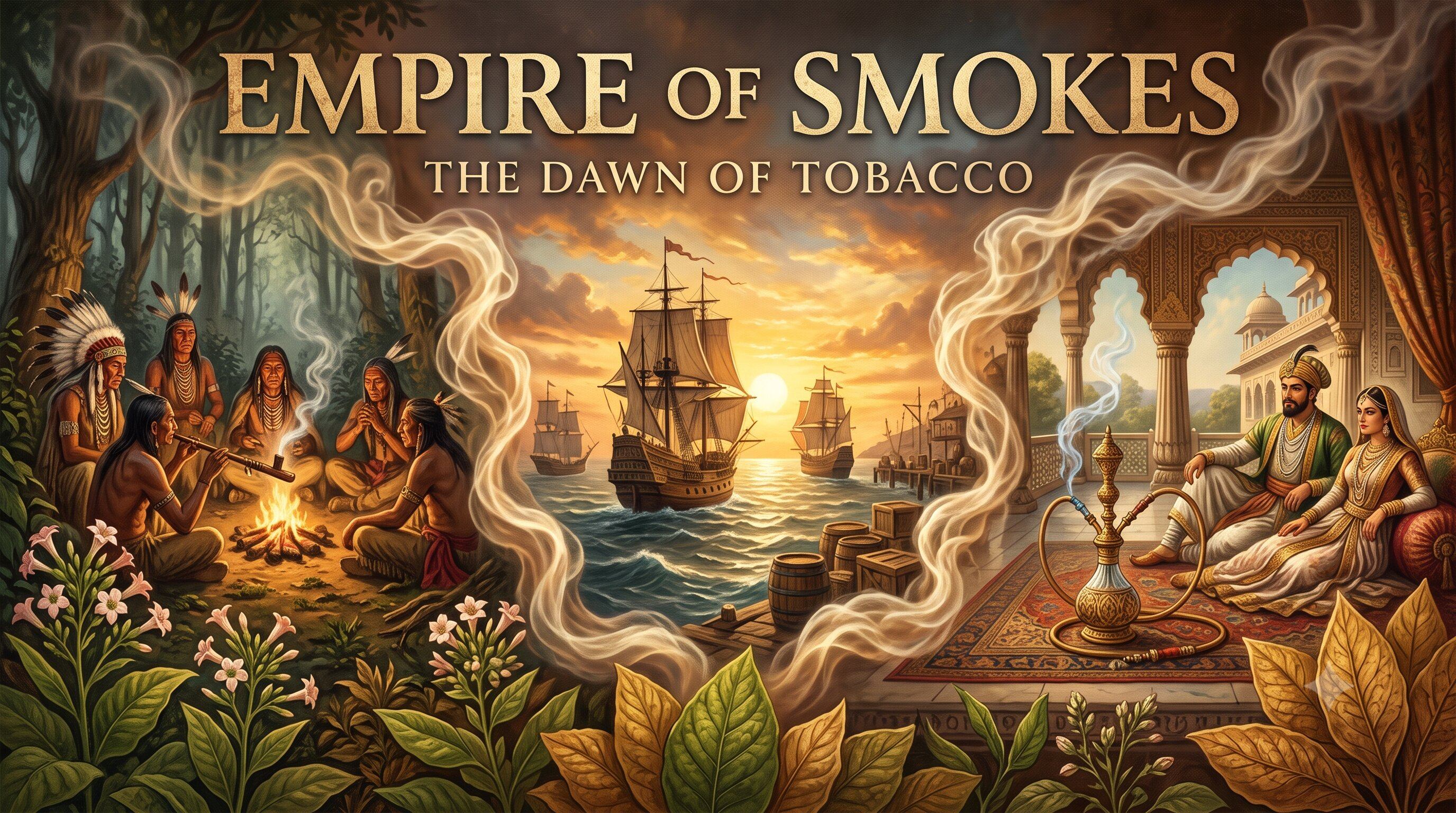
Long before the relentless hum of factory floors or the neon glow of modern advertising, the story of tobacco began in the quiet, sacred rituals of the Americas. For thousands of years, indigenous communities across North and South America cultivated Nicotiana tabacum and the highly potent Nicotiana rustica. In these early, deeply spiritual societies, the plant was never intended for mindless, habitual consumption.
It was a botanical bridge to the divine, treated with a mixture of reverence and caution. Native American shamans and elders burned tobacco as a fragrant offering to spirits, smoked it in intricately carved ceremonial peace pipes to seal treaties between warring factions, and ground it into poultices applied topically to heal grievous wounds. The smoke they inhaled was heavy, harsh, and deeply respected. It was a tool of solemnity and meditation, not a casual habit to fill the idle, anxious hours of the day.
Colonialism
This profound spiritual reverence, however, was entirely lost on the European explorers who arrived on the shores of the New World at the turn of the 16th century. To the Spanish conquistadors, the Portuguese sailors, and later the English settlers, tobacco was not a sacrament; it was a wildly lucrative novelty. When early colonizers realized the powerful, addictive pull the plant had on European consumers, they systematically stripped tobacco of its spiritual context and transformed it into a cornerstone of early global capitalism.
The establishment of the first permanent English settlement in the Americas was Jamestown, Virginia, in 1612. It was financially salvaged almost entirely by the aggressive cultivation of tobacco. John Rolfe, an early settler, introduced a sweeter strain from Trinidad that thrived in the Virginia soil, creating a massive cash crop. But this insatiable European demand exacted a horrific, incalculable human toll.
Slavery
Tobacco is a notoriously labour-intensive crop that rapidly depletes soil nutrients, requiring constant expansion and gruelling manual labour. To maximize profits and keep the leafy gold flowing across the Atlantic, European colonial powers turned to the transatlantic slave trade. They built vast, brutal plantation economies entirely on the backs of enslaved African men, women, and children. By the 17th century, tobacco had ceased to be a localized ceremonial herb; it had become a vital, bloody global currency. Packed tight in the dark, humid holds of wooden galleons, it began a relentless march across the oceans, eventually finding its way into the beating hearts of the world’s greatest empires.
Welcome to India
The arrival of tobacco on the Indian subcontinent was a relatively quiet event that would permanently alter the cultural landscape of South Asia. Portuguese merchants, relentlessly seeking to expand their maritime trade networks and spice routes, are widely believed to have introduced the plant to the western coast of India around 1605.
They first cultivated it in the rich, fertile soils of Gujarat. From those bustling coastal ports, the broad green leaf steadily made its way inland, eventually catching the attention of the continent’s ultimate tastemakers: the opulent, sprawling courts of the Mughal Empire.
Invention of Huqqah
During the reign of Emperor Akbar, the Mughal elite were constantly seeking novel luxuries and refined experiences. While the smoking of cannabis and hashish had been present in the region for centuries, tobacco offered a distinctly different, stimulating jolt that quickly became the absolute height of courtly fashion. However, there was a significant, physical problem. The early iterations of tobacco were incredibly harsh, leaving the noblemen with burning lungs, watering eyes, and raw throats.
Emperor Akbar’s court was filled with brilliant minds, among them a highly esteemed, forward-thinking physician named Hakim Abu-Fath Gilani. Watching the powerful men of the empire cough and hack through their expensive new habit, Gilani grew deeply concerned about the physical toll the hot smoke was taking on the human body. Applying his medical ingenuity to a recreational problem, Gilani set out to “purify” the tobacco smoke. He devised an elegant contraption where the harsh, burning smoke was drawn through a vessel of cool water before reaching the lungs, theoretically stripping it of its impurities and cooling the burn. Though modern science tells us otherwise. This brilliant invention was the birth of the huqqah, known in the West as the hookah or water pipe.
Addiction to Art
What began as a physician’s earnest attempt at harm reduction rapidly blossomed into a sprawling art form. The huqqah became the ultimate, undeniable symbol of Mughal aristocratic status and boundless hospitality. The water vessels were no longer mere utilitarian objects; they were commissioned as magnificent, glittering works of art.
Master artisans crafted massive bases from clear, imported European glass, layering them with intricate gold leaf. Others used heavy, silver-inlaid Bidri metalwork from the Deccan plateau, or carved solid blocks of nephrite jade, encrusting the surface with rubies, emeralds, and sapphires. Successive Mughal emperors, right down to the final ruler Bahadur Shah Zafar, became fiercely devoted to their intricate, bubbling water pipes.
Crucially, the huqqah was never an exclusively male indulgence. Historical records and stunning imperial miniature paintings from the era frequently depict royal women and empresses, such as the powerful Qudsia Begum, reclining on marble terraces, draped in fine, diaphanous silks, gently holding the long, velvet-wrapped stem of a huqqah. It became a vital anchor of social life within the royal harem.
To the common masses
Over time, as tobacco cultivation spread relentlessly across the Indian countryside, the habit naturally trickled down from the velvet-lined courts to the dusty, bustling streets. More portable, inexpensive methods of smoking were invented by the working class, such as the earthen chillum and the hand-rolled bidi; a small pinch of tobacco tightly wrapped in a dried tendu leaf. Through these adaptations, tobacco transcended all class barriers, becoming an unshakable, ubiquitous pillar of Indian daily life.
This was the part 1 in my tobacco series. In this part we seen how tobacco reached to the one great civilisation, in next part we will see how it reached to the another great civilisation i.e. China and its consequences.