If you open any introductory economics textbook, you will find a universal, seemingly unbreakable rule: corruption is the enemy of prosperity. It acts as a parasitic tax on business, chases away foreign investment, and redirects vital resources from schools and infrastructure into the offshore bank accounts of kleptocrats.
If you plot global economies on a graph with corruption on one axis and poverty on the other hand almost every nation forms a neat, predictable line.
Then, there is China.
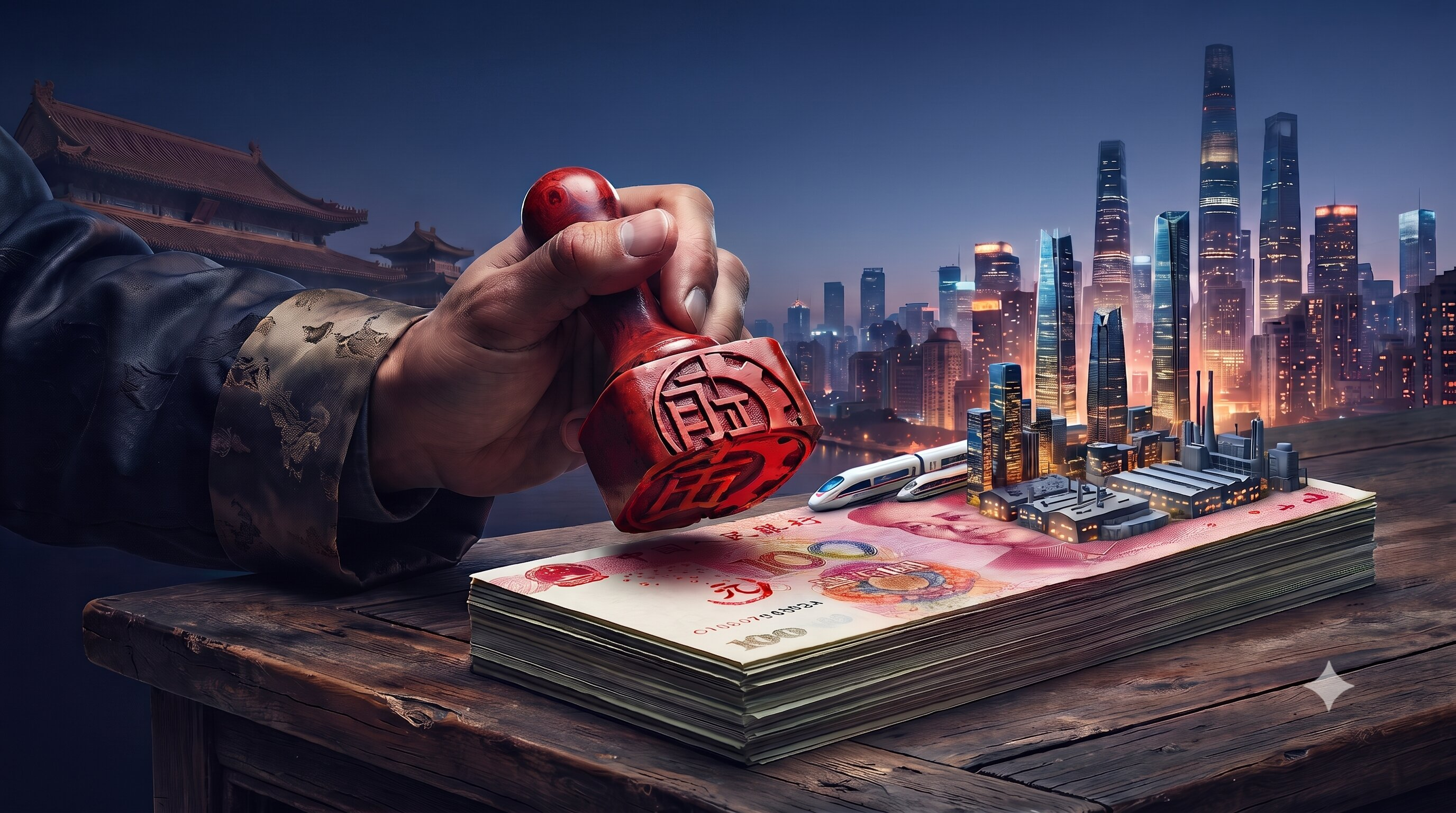
For the last four decades, China has been a glaring, multi-trillion-dollar outlier. It is a nation plagued by systemic, deeply entrenched corruption, yet it simultaneously executed the most rapid economic expansion in human history. Between 2012 and 2017 alone, the Chinese Communist Party disciplined a staggering 1.5 million officials for corruption. By all conventional economic logic, this level of institutional rot should have triggered a collapse. Instead, it built skyscrapers, high-speed rail networks, and a manufacturing empire.
How did a nation weaponize its own corruption to fuel growth, rather than suffocate it? The answer lies in a masterclass of twisted incentives and corporate-style commissions. Let’s do a deep dive on How China weaponized the corruption for economic growth.
The Bureaucrat’s Dilemma
To understand the Chinese economic paradox, you first have to look at how the country is actually run. The central government in Beijing sits at the top of a sprawling bureaucratic pyramid consisting of roughly 50 million state employees.
This creates a massive “principal-agent” problem. In the corporate world, shareholders (the principals) constantly struggle to ensure that local managers (the agents) act in the company’s best interest rather than lining their own pockets. In China, Beijing dictates the grand vision, but it relies on millions of local and provincial bureaucrats to actually make it happen.
These bureaucrats have immense localized power, but they are dramatically underpaid. While the average nationwide monthly wage in China sits around $1,298, the lowest-paid civil servants make a meagre $80 a month, and even the highest-paid cap out at just $824.
Historically, giving a human being immense regulatory power but paying them poverty wages is a recipe for disaster. It breeds extortion. A building inspector who cannot afford rent will naturally shake down local businesses just to survive. But Beijing managed to engineer a system where, instead of squeezing local businesses dry, these underpaid bureaucrats became their fiercest advocates. And let me help you to know the how part.
Flavors of Corruption
The turning point in understanding this paradox comes from the realization that not all corruption is created equal. Professor Yuen Yuen Ang, a leading political economist whose research heavily informs this economic anomaly, categorizes corruption into four distinct types. It is not the amount of corruption that determines a country’s economic fate, but the type.
- Grand Theft: This is pure embezzlement by high-level elite politicians draining public coffers to buy superyachts or luxury real estate overseas. This is entirely destructive to an economy. Here other side totally lose.
- Petty Theft: Low-level shakedowns. A police officer demanding a bribe to tear up a ticket, or a health inspector threatening to close a restaurant unless paid off. This is a direct tax on the working class and stifles local enterprise. It’s a hassle on public.
- Speed Money: Bribes paid to bypass bureaucratic red tape. This is a transactional exchange the payer gets a permit processed faster. It implies a clunky system, but it at least allows business to move forward. Here, something is being returned.
- Access Money: High-stakes exchanges that make both the briber and the official vastly better off. It is the buying of exclusive privileges, cheap land, government contracts, or tax breaks. The real deal, where everyone is better off. The official is getting money or gifts, the business is getting job done, bosses are getting economic numbers and public is getting much needed infrastructure.
Whenever we think about corruption, generally either we are talking about Grand Theft or Petty Theft.
China’s economic miracle did not happen because it eliminated corruption. It happened because the state systematically crushed petty theft while quietly institutionalizing access money. That’s the genius of the Chinese system.
The Commission-Based Economy
In China, access money evolved to function less like a mafia shakedown and more like an investment bank’s profit-sharing model.
Local officials are evaluated by their superiors almost entirely on one metric: regional economic growth. If a mayor’s city booms, that mayor gets promoted. But to generate that growth, the mayor needs the enthusiastic cooperation of those thousands of poorly paid subordinate bureaucrats.
To bridge the gap between their low salaries and the high expectations, the system allowed local agencies to retain a portion of the fees, taxes, and revenues they collected. This money wasn’t handed out in cash; it was distributed as lavish unofficial perks—housing subsidies, extravagant meals, luxury vacations, and hidden bonuses. When you factor in these “unofficial” benefits, a bureaucrat’s formal salary only accounts for about 24% of their actual total compensation. Even the google employee would be jealous of the perks.
This created an incredibly potent incentive structure. If you are a local official, shaking down a small noodle shop for a $50 bribe is short-sighted and risky. But if you can attract a major tech manufacturer or a massive retail distribution centre to your district, your region’s tax base explodes. You hit your growth targets, your boss gets promoted, and your department’s “unofficial perk” budget swells exponentially.
You are no longer a corrupt regulator; you are a commission-based sales rep for your city.
Because of this structure, local governments began fiercely competing with one another to act as concierges for massive corporations. When companies like Walmart, Apple, or Tesla look to expand in China, they aren’t met with bureaucratic roadblocks. They are met by local officials willing to clear land, build connecting roads, suppress labor disputes, and fast-track permits, all to secure the investment. The corruption essentially became a highly effective, albeit illicit, corporate subsidy.
The Cost
While this model successfully dragged hundreds of millions of people out of poverty, it is not a victimless system. The American equivalent to this era is the Gilded Age of the late 19th century a time of explosive railroad and industrial growth fueled by crony capitalism, monopolies, and bought-and-paid-for politicians.
Access money prioritizes growth at any cost, which inevitably leads to reckless behavior. Because bureaucrats were incentivized to build massive projects to boost GDP figures and secure kickbacks, China developed a severe addiction to real estate and infrastructure spending. This birthed the phenomenon of “ghost cities” entire metropolises built with borrowed money that remained empty and laid the groundwork for catastrophic corporate debt crises, most notably the recent collapse of real estate giant Evergrande.
Furthermore, access money inherently favors the elite. It enriches well-connected billionaires and powerful party officials while driving massive wealth inequality. The system that built the modern Chinese economy eventually became the greatest threat to its social stability.
The Tiger and the Fly
This brings us to the modern era and President Xi Jinping’s sweeping anti-corruption campaign, famously targeting both “tigers” (high-ranking officials) and “flies” (low-level bureaucrats).
Beijing recognized that the “access money” model had reached its expiration date. The astronomical debt, the speculative housing bubbles, and the simmering public resentment over extreme wealth inequality threatened the legitimacy of the state.
China is now attempting a precarious transition. It is trying to dismantle the profit-sharing, access-money machinery that drove its rise, attempting to replace it with a more standardized, rule-of-law approach to business.
Whether an economy built on the scaffolding of highly incentivized, growth-driven corruption can sustain its momentum once that scaffolding is removed remains one of the great economic experiments of the 21st century. China proved that the right kind of corruption can build an empire. The question now is whether the empire can survive without it.
Till the next time. Bye!