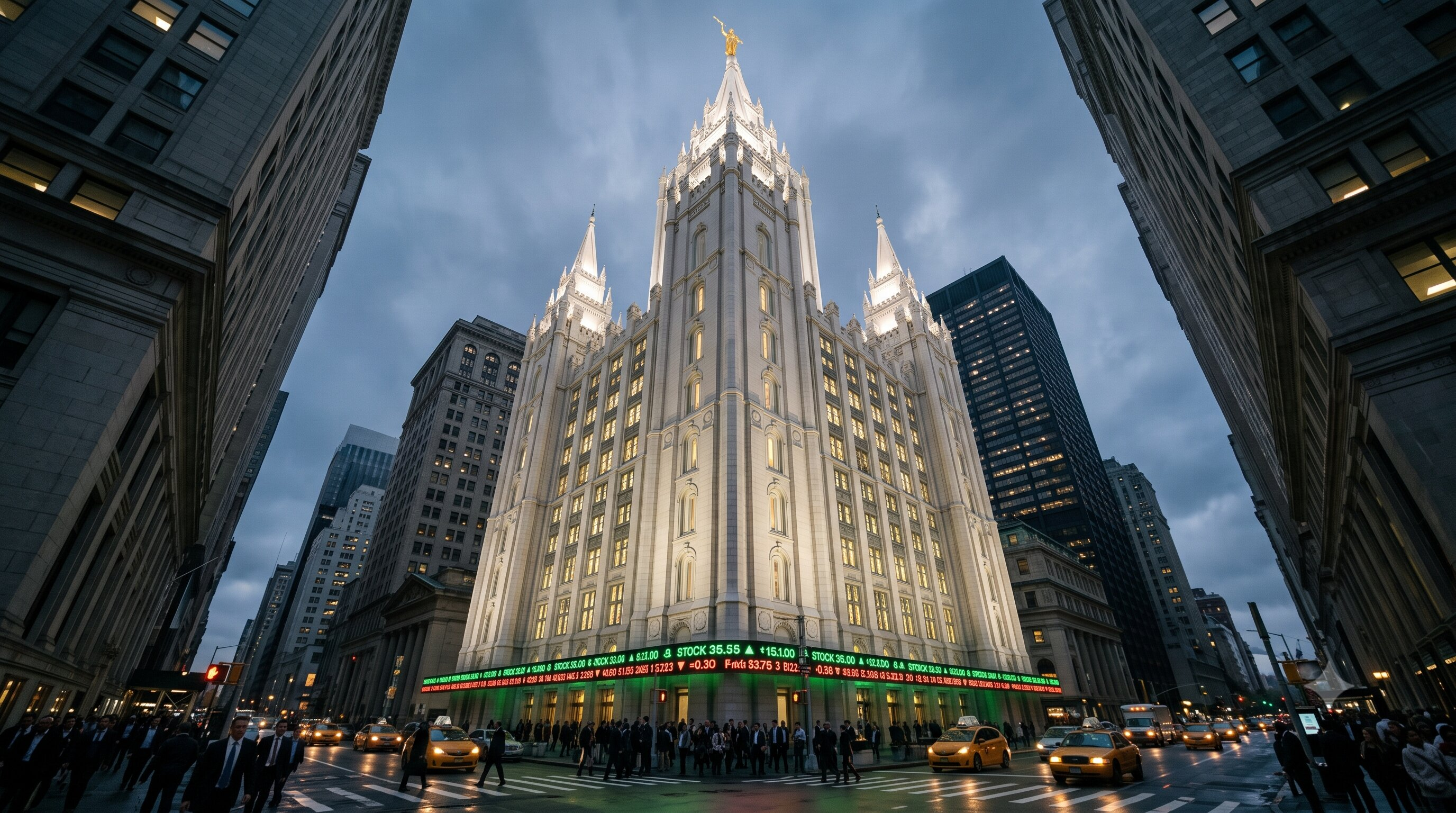
When you think of the world’s wealthiest and most powerful entities, you likely picture multinational mega-corporations like Coca-Cola, Disney, Apple, or Microsoft. You envision sprawling corporate campuses, armies of financial analysts, and ruthless hedge fund managers plotting their next market conquest. What you likely do not picture is a religious institution.
Yet, quietly operating alongside these titans of industry is an entity with an estimated $293 billion (29 lakh crore Indian rupees which is nearly half of Indian government’s annual budget) fortune: The Church of Jesus Christ of Latter-day Saints (LDS Church).
For decades, the Mormon Church has operated less like a traditional charity and more like a highly efficient, endlessly liquid sovereign wealth fund. Through a masterful combination of corporate restructuring, psychological conditioning, and aggressive financial strategy, a 19th-century polygamist pioneer movement has transformed itself into a hyper-Americanized, tightly controlled global religion with an investment portfolio that dwarfs the GDP of many nations.
How did a church get so much money? The answer lies at the intersection of religious devotion and ruthless corporate discipline.
The Corporate Church
To understand the Church’s financial empire, you have to look back to the 1970s. For much of its early history, the Church’s focus on land and wealth was rooted in a theological desire for self-sufficiency a survival mechanism born from the intense financial strains and government persecution of the 19th century. To shed its image as a group of radical outcasts, the Church overcompensated, rebranding itself around the ideal of the American nuclear family and mainstream corporate aesthetics.
But the true financial pivot occurred when the Church began drafting high-powered corporate executives into its senior leadership. Figures like N. Elden Tanner, a highly successful oil tycoon, were brought in to apply Wall Street discipline to the Church’s surplus tithing. The institution transitioned from a frontier religion into an efficient, technocratic empire.
Leadership utilized spreadsheets, data auditing, and centralized branding to maintain global consistency. This standardization was born out of the “Correlation” movement in the 1960s, a widespread crackdown meant to centralize the hierarchy and end progressive theological debate. Every lesson, song, and architectural design was standardized so that a congregation in Peru received the exact same messaging as one in Utah. By merging divine mandate with modern corporate strategy, the Church built a scalable, centralized machine perfectly designed to maximize the financial yield of its followers.
The Price of Salvation: Free Labor and the 10% income
Most global mega-churches with massive operating budgets use their funds to pay their clergy, hire janitorial staff, and maintain local community activities. The Mormon Church does the exact opposite. It has effectively gamified religious devotion into a system of free, mandatory corporate labour.
At the very core of this staggering $293 billion fortune is the law of tithing. Members are strictly required to pay 10% of their gross income to the Church. This is not framed as a charitable suggestion; it is a transactional requirement for spiritual salvation. Members are taught that tithing is “fire insurance” for the impending apocalypse, and Church leaders have historically instructed that even destitute members should choose to pay their tithing over buying food for their own families. Yes, you read that right, church leaders have stated this.
Tithing is basically donation of 10% of the income to the church. It is mandatory for baptised and devout Mormon. Islamic equivalent of it would be zakat. Every religion has same concept like this with some twist. But unlike others, LDS is highly centralised and blessed with disproportionate high-income followers specially in the richest country of the world i.e. USA.
This financial extraction is enforced through the “Temple Recommend” interview. To access Mormon temples which is required to reach the highest tier of heaven and be eternally sealed to one’s family members must pass a rigorous 15-question interview with local leaders. This test verifies absolute obedience, belief in the prophet, and the payment of a full 10% tithe. By weaponizing family bonds and threatening eternal separation, the Church leverages a profound psychological grip to ensure financial compliance from people who often literally cannot afford it.
Yet, despite funnelling this massive stream of income to headquarters in Salt Lake City, the Church chronically underfunds its local congregations. Almost all local clergy, including bishops, are entirely unpaid. The Church relies on unpaid labour to keep its operating costs shockingly low: members are required to scrub the chapel toilets themselves for free, and they must purchase their own teaching supplies. Even the famous young missionaries who spend two gruelling years proselytizing for the faith do not get paid. Instead, they actually pay the Church $300 to $400 a month for the privilege of doing sales work for the institution. If any company was doing this, it would have been faced with lawsuits for such bad treatment of its employee, except it is a religious institution hence no consequences.
Financial Empire
Thus, where does this river of untaxed, surplus cash go? According to investigations like the Widows Mite Report, the LDS Church was estimated to be worth just under $300 billion by the end of 2024. Shockingly, roughly 65% of its expenditures are focused on reinvesting wealth to grow the portfolio, rather than on humanitarian aid.
The Church manages its vast stock holdings through a secretive investment firm called Ensign Peak Advisors. Rather than tying up its wealth in illiquid, expensive-to-maintain historical artifacts like the decentralized Catholic Church, the Mormon Church’s wealth is highly liquid. Ensign Peak pumps billions directly into the stock market, holding major shares in tech giants like Apple, Microsoft, and Nvidia.
Beyond Wall Street, the Church operates a sprawling, highly lucrative real estate empire through its commercial development arm, Property Reserve Inc. Fuelled by tithing and compound interest, the Church has become one of the largest private landowners in the United States, owning an estimated 2.4 million acres of land an area roughly the size of three Rhode Islands (A state of USA). This land is valued at upwards of $20 billion, a figure reporters note is highly underestimated due to a lack of disclosure requirements in certain states.
Under the leadership of commercial real estate veterans like Ashley Powell, who joined in 2017, the Church has pivoted from holding raw agricultural land to aggressively developing luxury apartments, hotels, warehouse portfolios, and massive master-planned communities. One prime example is “Tributary,” a 1,000-acre development in Aurora, Colorado, slated to house 12,000 people.
In the cutthroat world of commercial real estate, the Church possesses the ultimate competitive advantages: infinite liquidity and infinite patience. Because it is funded by a continuous stream of untaxed tithing and an existing reserve that managed over $60 billion in assets, the Church makes all-cash offers and carries zero debt. In 2021, the Church effortlessly outbid billionaire Bill Gates for a $210 million bankrupt portfolio of Washington state farmland. Furthermore, while traditional developers look to flip properties in 10 to 20 years, the Church plans on a 50-to-100-year generational horizon, allowing it to weather market downturns that would ruin typical investors.
The Church also runs numerous for-profit corporate businesses, including Deseret Book, Deseret News, Bonneville International radio, life insurance companies, and the sprawling luxury City Creek Mall in downtown Salt Lake City.
SEC Scandal
This relentless transition into commercial land development and high-finance capital accumulation has raised severe ethical concerns. The starkest tension lies in the Church’s extreme demand for personal transparency from its members versus its own institutional secrecy.
Members are subject to intense, face-to-face financial and purity audits with their local bishops. They must be entirely transparent about their incomes and their sins. However, the institution itself actively obfuscated its own financial health from its members and the government. To shield its wealth from taxes and lawsuits, the Church relies on the United States’ strict religious freedom laws and an army of lawyers from the firm Kirton McConkie, which boasts 98 partners and 173 attorneys.
But in 2019, an IRS whistleblower named David Nielsen shattered this secrecy. It was revealed that the Church and Ensign Peak Advisors went to “great lengths” to conceal the vast scope of their investments by using 13 illegal shell companies. Why? Because Church leadership feared that if everyday members knew the institution was sitting on hundreds of billions of dollars in liquid cash hoarded as a “rainy day fund” for the Second Coming they might stop paying their 10% tithing.
This deception ultimately resulted in a $5 million fine from the Securities and Exchange Commission (SEC) in 2023. For an institution built on moral authority and absolute honesty, operating as a clandestine hedge fund created a massive cultural turning point.
The consequences of this wealth hoarding extend beyond the congregation. The Church’s real estate development strategy, which favours aggressive urban sprawl, has sparked severe community pushback. For instance, when the Church attempted to annex 52,000 acres of its Deseret Ranch land in Florida an area larger than Manhattan and San Francisco combined—for developer-friendly concrete expansion in 2024, local resistance halted the project over threats to the environment and water usage. The Church’s holdings are now so vast that its internal corporate decisions unilaterally dictate the urban planning and ecological health of entire American counties.
Fate of the Faithful
When a religion operates indistinguishably from a Fortune 500 company, the human cost is immeasurable. The revelations of the Church’s financial secrecy have forced many believers into a painful state of cognitive dissonance. Everyday members must reconcile the harsh reality that they sacrificed family vacations, scrubbed chapel toilets for free, and handed over 10% of their livelihoods to fund an organization sitting on hundreds of billions of dollars that gives less than 1% of its wealth to actual charity.
For those who choose to leave, the psychological toll is devastating. Because the Church claims the authority to define a person’s worthiness, untangling one’s identity from the institution requires tearing down and rebuilding an entire psychological foundation. Former members are left to grapple with the realization that their morality, their work ethic, and their deeply held beliefs were systematically programmed by a centralized corporate committee in Salt Lake City.
By combining the tax-exempt status of a religion, the ruthless efficiency of a Wall Street investment firm, and the psychological control of a high-demand faith, the Mormon Church has created an unprecedented wealth-generating machine. It is a staggering empire built on spreadsheets, shell companies, and the unbreakable devotion of everyday people paying for a paradise they were told they could not afford to lose.
I will be back with something new. Stay Tuned. Till then, Bye!