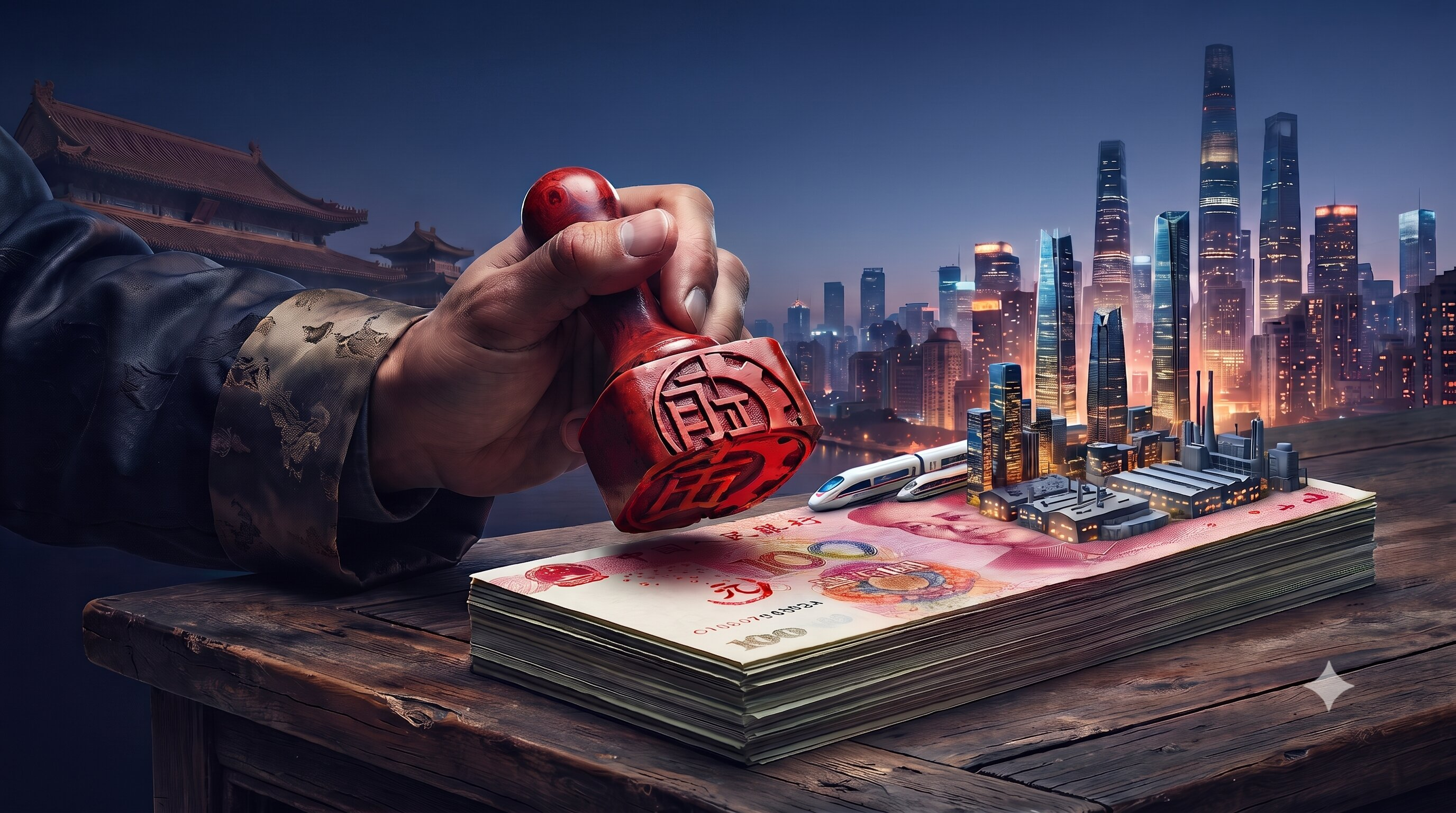
For years, top American tech companies like Apple have manufactured in China, inadvertently helping it become the technological juggernaut it is today.
Headlines over the past two years have been dominated by Apple’s aggressive, multi-billion-dollar supply chain migration to India and Vietnam. Pundits have been quick to declare the end of “iPhone City.” Yet, beneath the geopolitical theatre and the massive factory expansions in South Asia, a more complex truth remains: Apple is executing one of the greatest supply chain pivots in modern corporate history, but it is not abandoning Beijing.
To understand the trillion-dollar paradox of why Apple is simultaneously breaking China’s manufacturing monopoly while remaining inextricably tied to it, we have to dismantle the myths of why Apple went there in the first place.
The Myth of Cheap Labour
A persistent and fundamental misunderstanding is that Apple manufactures in China simply to save money on wages. In reality, assembling an iPhone in China costs roughly $40 in labour. If Apple were to move that assembly to the United States and pay American entry-level factory wages, the retail price of a premium iPhone would only increase by about $146. For a luxury device where consumers routinely pay more than that just to upgrade their storage capacity, a $146 premium would be a negligible price to pay for total geopolitical independence. If cheap labour were the true north star, Apple would have fully abandoned China for India or Southeast Asia a decade ago.
The real challenge Apple solved in China was never cost; it was scale and velocity.
Apple does not just make phones; it manufactures approximately 590 devices every single minute to meet hundreds of millions of orders a year. Complicating this monumental task is Tim Cook’s famous operational philosophy that holding inventory is “fundamentally evil.” Cook views sitting electronics much like dairy products—they spoil rapidly in value. Consequently, Apple turns over its entire global inventory roughly 74 times a year. From the moment an iPhone leaves a factory floor in China, it takes an average of just five days to reach a consumer’s hands halfway across the world.
Consumer demand spikes massively between the September launch and the Christmas holiday season. Consequently, Apple requires a manufacturing partner capable of instantly doubling its workforce to meet the rush, and cleanly dismissing those workers when demand cools in January.
Doing this in a standard Western economy would be impossible. Hiring a million workers in the fall and firing them in the winter would collapse local welfare systems and spark mass social unrest. China is the only country structurally designed to handle this, largely due to its Hukou system.
The State- Enforced Caste system
Hundreds of millions of rural Chinese citizens are legally permitted to migrate to wealthy industrial mega-cities to work, but they are strictly barred from using the city’s public services like schools and hospitals, because their residency remains registered to their rural hometowns. This creates a permanent, highly transient, and legally disadvantaged underclass.
Contract manufacturers like Foxconn have exploited this system intentionally. The gruelling 12-to-14-hour shifts and depressing factory environments in places like Zhengzhou are features, not bugs; they ensure the average worker leaves after just 68 days. When Foxconn needs extra hands to meet Apple’s brutal holiday deadlines, local governments literally bus in vocational students for mandatory “internships” to bridge the labour gap.
Despite global scrutiny, this dynamic remains the engine of Chinese tech manufacturing. A September 2025 undercover investigation by China Labor Watch into the production of the iPhone 17 revealed that conditions had not changed. Over 50% of the workforce were temporary “dispatch workers” (despite China’s legal limit of 10%), workers were subjected to 60-to-75-hour work weeks, and students were paid $1.70 an hour tied to their graduation requirements. This reliance on an expendable workforce ultimately triggered a formal complaint against Apple under the German Supply Chain Due Diligence Act in early 2026, highlighting the severe human cost of extreme supply chain flexibility.
Building from the Ground Up
Conventional wisdom suggests Apple simply outsourced to China. The truth is that in the early 2000s, China did not possess the technical competence to build what Steve Jobs and Jony Ive were dreaming up. No country did. To turn impossible prototypes into hundreds of millions of defect-free devices, Apple had to build that capability in China from the ground up.
Apple operates through an “upside-down funnel.” While a tiny elite group handles Industrial Design in California, the real magic happens in Manufacturing Design. Apple dispatches planeloads of its own engineers to Asian industrial clusters to work hand-in-glove with hundreds of factories, inventing the actual industrial processes, refining the metallurgy, and installing custom machinery.
This massive knowledge transfer hit a crisis point in 2013 when Xi Jinping took power. Viewing Apple as an exploitative Western corporation, Chinese state media launched attacks, and Beijing pushed for forced Joint Ventures. In response, Apple formed a “Gang of Eight” to quantify its true value to the local economy. In 2015, Tim Cook took this data directly to the CCP leadership in Zhongnanhai and made a staggering pledge: Apple would invest $275 billion over five years into China’s economy. The pitch worked overnight. Beijing realized Apple wasn’t just extracting profit; it was funding a corporate Marshall Plan.
Since 2008, Apple has trained roughly 28 million workers across its supply chain, with the vast majority in China, a labour force larger than the entire population of California.
Because Apple avoids relying 100% on any single supplier, it actively encouraged the Chinese factories it trained to take on other clients. This decision directly birthed Apple’s greatest rivals. Empowered by Apple-trained component makers, Chinese brands like Huawei, Xiaomi, Oppo, and Vivo surged to capture 55% of the global smartphone market.
This “spillover by design” allowed China to climb the economic “Smiley Curve” moving from low-margin assembly to mastering high-margin engineering. The consequences rippled into other sectors. When Tesla built its Shanghai Gigafactory, it used the exact same Apple playbook, upskilling local battery suppliers like BYD and CATL. Beijing calls this the “Catfish Effect”—throwing a predator into a tank to force the domestic sardines to swim harder. Within 24 months, China’s EV industry became a global juggernaut.
The Indian Exodus: Breaking the Monopoly
While avoiding U.S. tariffs through PR, Apple was quietly executing a very real, half-trillion-dollar migration to India.
Initially, India was just “tariff theatre.” When Prime Minister Narendra Modi imposed 20% import tariffs on smartphones in 2017, Apple had to start bolting together imported Chinese sub-assemblies in India just to sell to the local middle class without a punitive price hike. Between 2017 and 2024, India slowly ramped up to 15 million iPhones, mostly older models.
But as U.S.-China tensions boiled over in 2025, Apple initiated an explosive acceleration, deciding to shift assembly of virtually all U.S.-bound iPhones to India. The transition was brutal. Viewing technology transfer as a “one-way gate,” Beijing informally ordered Foxconn to recall over 300 Chinese engineers from Tamil Nadu and blocked factory machinery at customs in mid-2025.
Apple and India counter-attacked. Foxconn flew in Taiwanese engineers, and Apple heavily backed India’s domestic champion, Tata Electronics. By late 2026, Tata’s share of India’s iPhone exports skyrocketed to nearly 40%.
The shift was historic. By the fiscal year ending March 2026, India had churned out 55 million iPhones, capturing 25% to 26% of global production (up from just 6% in 2022). Indian factories were no longer relegated to base models; they began assembling the flagship iPhone 18 Pro and Pro Max from day one of launch. Today, India is Apple’s primary export hub for the American market. Vietnam, meanwhile, settled into a specialized role as the peripheral hub for iPads, MacBooks, and AirPods.
To move past simply bolting together Chinese parts, New Delhi unleashed the Electronics Components Manufacturing Scheme (ECMS). Backed by a massive ₹40,000 crore budget in early 2026, the program approved 106 component plants worth ₹69,548 crore ($8.3 billion). As of August 2026, 38 plants are already live, stamping metal enclosures, display modules, and camera assemblies locally.
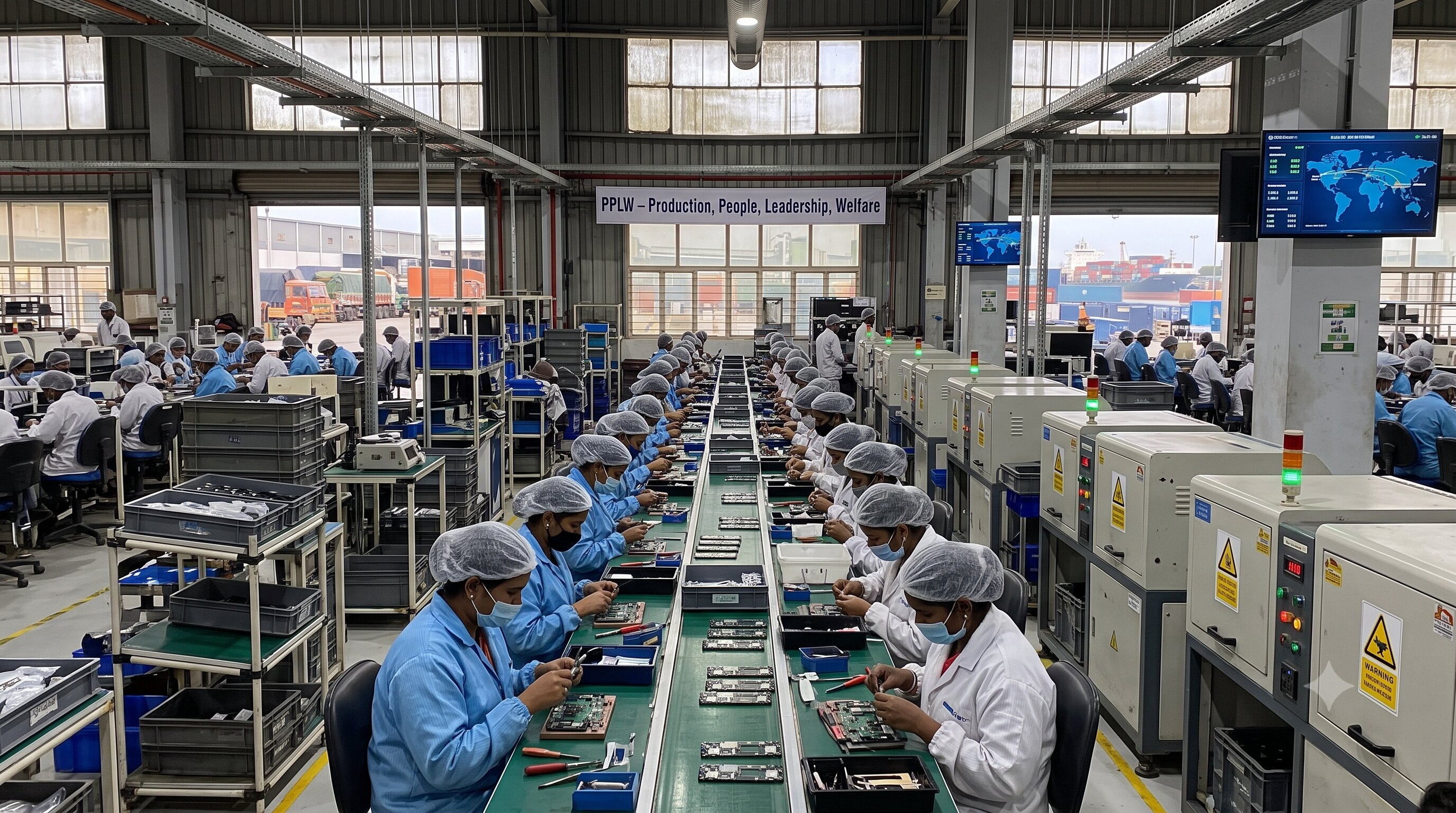
Crucially, southern Indian states are achieving this without relying on a dystopian equivalent to the Hukou system. Instead, they built ESG-compliant, “walk-to-work” industrial housing. Foxconn and Tamil Nadu state agencies constructed massive mega-dormitories for tens of thousands of female workers, complete with sports courts and grocery stores, designed for long-term career retention rather than 68-day disposable labour. This new democratic supply chain was formally solidified in February 2026, when the U.S. and India signed an Interim Trade Agreement, slashing reciprocal tariffs to 18% and legally aligning their technology ecosystems against China.
With India successfully manufacturing 1 in 4 iPhones globally, and domestic Indian Apple revenues crossing a record $10 billion in FY26, why doesn’t Apple just leave China entirely?
Because Apple is the ultimate geopolitical hostage.
Unlike Samsung, which successfully relocated its factories to Vietnam and India only after its Chinese consumer market share collapsed to less than 1%, Apple is deeply embedded in the Chinese consumer psyche. In Fiscal Q1 2026 alone, Apple’s Greater China revenue skyrocketed 38% to a staggering $25.53 billion. Apple makes more money in China in six weeks than it does in India in an entire year.
As Washington awoke to this reality, Apple found itself caught between two superpowers. However, the U.S. approach to decoupling was fundamentally flawed. Producing a million iPhones a day requires coordinating a billion distinct parts in a just-in-time ecosystem. The U.S. is decades behind in industrial tooling and lacks the workforce willing to endure seasonal factory shifts.
Beyond iPhone City: The Dual-Engine Strategy
As John Ternus steps into the CEO role, he takes over an enterprise that has successfully insulated itself against global trade wars by building a secondary manufacturing engine. Apple has proven that the seemingly impenetrable supply chain of “iPhone City” can, in fact, be fractured and rebuilt elsewhere. By aligning Indian production with American demand, tapping into local component subsidies, and strategically partnering with Alibaba to maintain its technological edge in China, Apple has managed an extraordinarily delicate balancing act.
Apple will not abandon China. The sheer scale of its 100-million-strong affluent consumer base and the unparalleled efficiency of Shenzhen’s component clusters make a full exit impossible. However, the events of 2025 and 2026 demonstrate that Apple is no longer entirely dependent on a single nation. It is choosing to operate a vastly more resilient, bifurcated global network—one capable of appeasing Washington, satisfying Beijing, and driving its next era of growth from Bengaluru.
In this blog i have discussed about China being superpower in EV in just 24 months. Next time we might discuss this. Till then, Bye