If you stood on a street corner in Beijing in the year 2000, the soundtrack of the city was the rhythmic, metallic hum of millions of bicycles. In a nation of 1.3 billion people, there were only 4 million cars on the road.
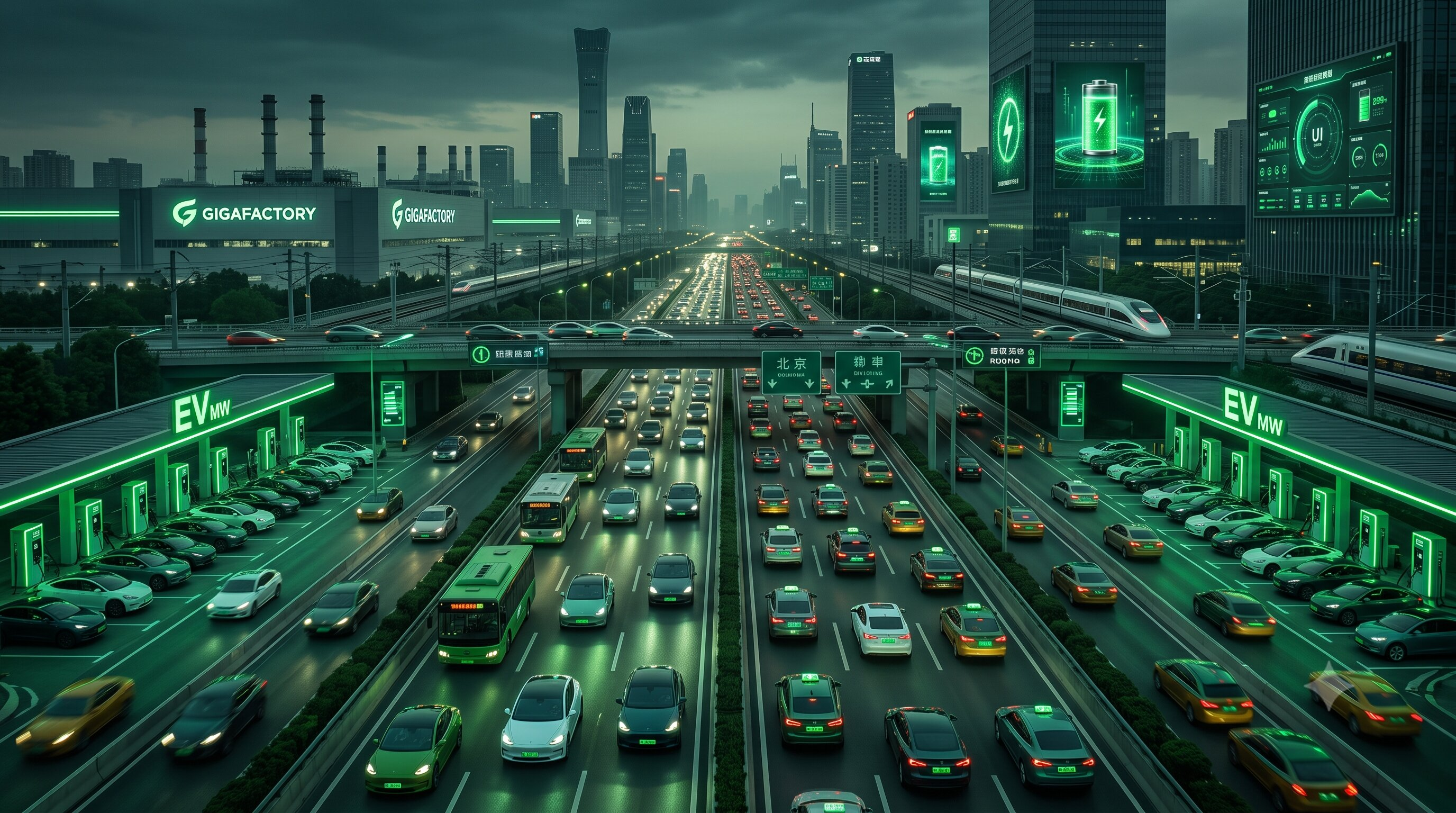
Fast forward to late 2026, and the sensory experience has completely transformed. The streets are now dominated by the silent, hyper-advanced glide of electric vehicles (EVs). By September 2026, the adoption rate reached a staggering milestone: over 70% of all new passenger vehicles sold in China were plug-ins.
The narrative in the West often dismisses China’s EV dominance as an accident of timing or the result of endless government blank checks. The reality is far more calculated. China’s ascent is a multi-decade masterclass in industrial strategy—a three-act play of state coercion, ruthless capitalism, and technological leaps that has split the global auto industry into two parallel universes.
Here is the inside story of how the electric empire was built.
Act I: The Burning Platform
By 2005, China’s car ownership had tripled, triggering two existential crises for Beijing: geopolitics and smog.
First, China was dangerously thirsty for oil. It consumed roughly 13% of the world’s oil but held only 1.5% of global reserves. The vast majority of its imported crude arrived on tankers passing through maritime chokepoints heavily monitored by the U.S. Navy. Relying on geopolitical rivals to keep the country moving was a glaring national security vulnerability.
Second was a devastating public health crisis. Urban smog from vehicular exhaust was choking China’s wealthiest cities, causing an estimated 4,000 pollution-related deaths every single day.
For decades, China had tried to build a domestic auto industry by forcing foreign giants like Volkswagen and Toyota into 50/50 Joint Ventures (JVs) with local firms. The goal was technology transfer, but it failed. Chinese automakers grew complacent. They realized they could never overcome the century-long head start German and Japanese engineers had in mastering the thousands of precision-machined moving parts inside an internal combustion engine (ICE).
So, Beijing flipped the board.
They realized an EV isn’t a mechanical marvel; it’s effectively a giant battery wrapped in software and steel. This aligned perfectly with China’s existing dominance in consumer electronics and smartphone supply chains.
To jumpstart this new industry, the government became the ultimate early adopter. Post-2008 stimulus funds bought massive fleets of electric buses. By 2017, Shenzhen became the first city on earth to electrify its entire fleet of 17,000 buses, guaranteeing early production volume for domestic battery makers long before private consumers were ready to buy.
But the real secret weapon wasn’t just cash subsidies. It was the Green License Plate.
To curb smog, major Chinese cities severely rationed gas-car plates. In Beijing, the odds of winning a gas-car plate lottery were effectively 1 in 600; in Shanghai, a plate could auction for over $10,000. But if you bought an EV? You received a Green License Plate immediately, for free. It bypassed the lotteries and granted you full driving privileges seven days a week.
This psychological and legal coercion worked almost too well. It spawned a massive bubble of roughly 500 subsidized EV startups churning out identical, low-range vehicles. As battery tech rapidly advanced, early models became obsolete overnight, resulting in dystopian “EV graveyards” of abandoned first-generation cars outside major cities.
Beijing had built the foundation, but it was bloated and weak. It was time to cull the herd.
Act II: Enter the “Catfish”
Recognizing that 500 mediocre companies couldn’t take on the world, the Chinese government made a counterintuitive move: they let ruthless free-market capitalism take the wheel.
They began phasing out direct consumer subsidies and banned local governments from bailing out failing brands. Then, they invited the 800-pound gorilla into the ring.
In Chinese business strategy, there is a concept known as the “Catfish Effect”. If you put a predatory catfish in a tank of sluggish sardines, the sardines will swim frantically to survive, staying fresh longer. Breaking decades of protectionist precedent, Beijing allowed Tesla to build its massive Gigafactory in Shanghai with 100% foreign ownership—no joint venture required.
Tesla was the catfish.
Once established, Tesla slashed prices, sparking a brutal domestic price war. To survive, Chinese brands had to innovate, cut costs, or die.
The bloodbath was spectacular. Within a few years, roughly 80% of China’s EV startups collapsed. But the survivors—companies like BYD, NIO, and Xpeng—emerged as battle-hardened titans. While the U.S. market effectively offered buyers only a handful of competitive EV models, Chinese automakers were launching over 100 new EV models a year, iterating at the speed of Silicon Valley software updates.
By late 2023, the crucible had forged global champions, and China officially overtook Japan as the world’s number one auto exporter.
Act III: The Endgame
As we look at the global automotive landscape today in late 2026, the divergence between China and the USA is absolute. We are now looking at two entirely different industries.
++The U.S. Retreats Behind the Wall++
In the United States, the grand strategy of out-subsidizing China has fractured. Today, America has retreated behind a wall of pure protectionism, levying a 100% tariff on Chinese EVs and steep tariffs on Chinese battery cells. Consequently, the U.S. EV market remains sluggish, burdened by high prices and a fragmented charging infrastructure, while plug-in adoption hovers in the low double-digits.
- ++The LFP Battery Revolution++
Meanwhile, the myth of the “low-spec, short-range” Chinese EV has been entirely shattered. The West spent years heavily relying on Nickel-Manganese-Cobalt (NMC) batteries—which are expensive, prone to thermal runaway, and reliant on fraught supply chains.
Chinese battery giants like CATL and BYD bypassed this bottleneck by perfecting Lithium Iron Phosphate (LFP) batteries, which now dominate domestic installations. LFP is cobalt-free, radically cheaper, and virtually fireproof. Paired with high-voltage architectures, modern Chinese EVs now lead the world in range. Top-tier hybrid and EV models from brands like BYD now boast combined ranges exceeding 1,000 kilometers, supported by a domestic network of megawatt flash-chargers that can add hundreds of kilometers of range in under ten minutes.
- ++The “China + 1” Global Expansion++
Faced with a saturated domestic market and steep European and American tariffs, Chinese giants are no longer just exporting cars on cargo ships. They have initiated a massive “China + 1” strategy, aggressively building localized mega-factories in Hungary, Turkey, Brazil, and Thailand to sell their vehicles from directly behind Western tariff walls.
The Student Becomes the Master
In a supreme historic irony, the corporate hierarchy of the 20th century has been turned entirely upside down. Legacy foreign automakers, who once commanded 60% of the Chinese market, have watched their share plummet.
Instead of forcing foreign carmakers into joint ventures to steal their tech, the tables have turned: legacy automakers like Volkswagen and Stellantis are now pouring billions of dollars into Chinese EV startups just to gain access to their electronic architectures and software platforms.
The transition from bicycles to the world’s most advanced mobility ecosystem wasn’t a fluke. By identifying a technological shift early, utilizing state levers to guarantee scale, and deliberately triggering a brutal, survival-of-the-fittest free market, China didn’t just win the electric vehicle race.
They entirely rewrote the rules of the global automotive industry and the rest of the world is still trying to catch up.
China is just dominating the green tech, sadly India is nowhere in the scene. Hope policymakers in India do something about it. Me and you can only hope. Bye!