For years, Wall Street’s most secretive trading firms operated in India quietly, extracting massive profits from the country’s booming retail options market without drawing public attention. That silence shattered in a Manhattan federal courtroom in April 2024.
Jane Street, a quantitative trading titan, had filed a lawsuit against rival hedge fund Millennium Management, alleging that two defecting traders stole a “highly valuable, unique, and proprietary trading strategy.” During the proceedings, Millennium’s defence team inadvertently revealed the billion-dollar secret: the highly lucrative strategy was simply trading Indian index options.
Although the two firms settled the lawsuit by December 2024, the courtroom revelations set off alarm bells 8,000 miles away in Mumbai. Indian regulators at the Securities and Exchange Board of India (SEBI) and the National Stock Exchange (NSE) realized that Wall Street sharks were extracting billions from a structural quirk in their markets. Between January 2023 and March 2025, Jane Street had netted roughly $4.3 billion in profits from India accounting for nearly 14% of the firm’s total global trading revenue in 2023.
The ensuing regulatory crackdown would result in a landmark 105-page enforcement order, a $560 million penalty, and a fierce ongoing debate about where to draw the line between textbook arbitrage and illegal market manipulation.
The 8-Minute, $86 Million Trade
To understand SEBI’s allegations, we must look at the centerpiece of their investigation: January 17, 2024.
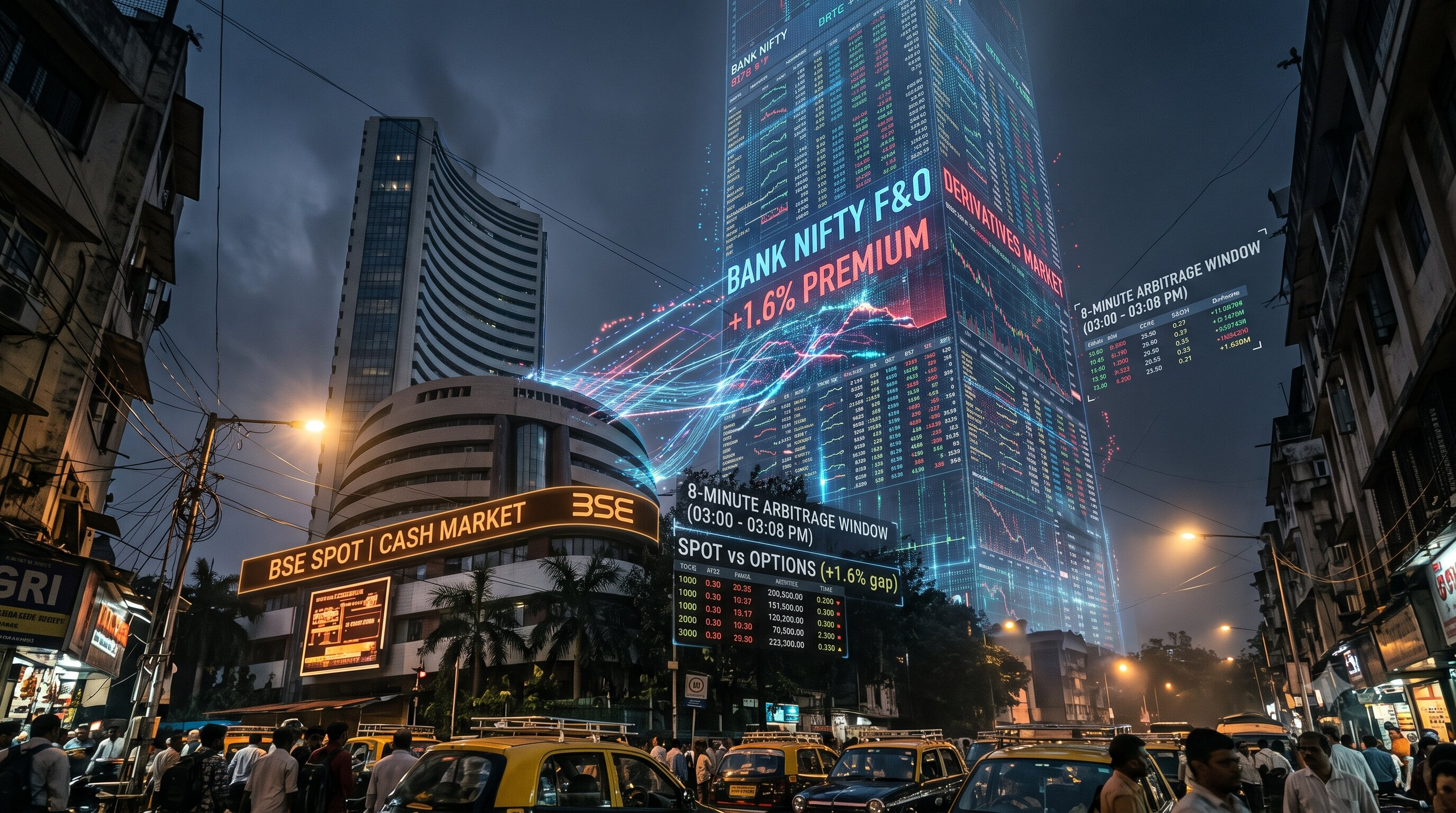
On that Wednesday, the Bank Nifty index (a basket of India’s largest banking stocks) was experiencing a highly volatile expiry day. Retail traders, hungry for leverage, were aggressively buying call options, hoping the index would surge. This retail frenzy pushed the implied value of the Bank Nifty options market to a massive 1.6% premium above the actual underlying cash index.
Sensing the mispricing, Jane Street’s algorithms went to work. In a span of just 8 minutes, the firm bought $67 million worth of underlying banking stocks, single-handedly lifting the Bank Nifty index by over 1%. In total, Jane Street’s net trading value that day hit $511 million which is representing up to 25% of the total trading volume in several major bank stocks and more than three times the volume of the next largest market participant. By the end of the session, the firm had netted an astonishing $86 million in a single day.
The “Two-Patch” Playbook: SEBI’s Case for Manipulation
On July 3, 2025, SEBI issued an ex-parte (from one party, Court procedures normally require all parties to be notified and given a chance to speak. An ex parte action is a rare exception to this rule) interim order banning Jane Street from Indian markets and impounding ₹4,843.57 crore (roughly $560 million) in alleged unlawful gains. SEBI accused the firm of executing an intentional “Intraday Index Manipulation” strategy, which they dubbed the “Two-Patch” playbook:
- Patch 1 (The Morning Pump): SEBI alleged that Jane Street aggressively bought massive quantities of Bank Nifty constituent stocks. By representing over 20% of the market volume, they artificially pushed the index price upward. Simultaneously, in the hyper-liquid options market, the firm built a massive bearish position—selling expensive calls and buying cheap puts.
- Patch 2 (The Afternoon Dump): Once their massive bearish options book was locked in, Jane Street rapidly dumped all the underlying stocks and futures they had bought in the morning. This massive sell-off drove the index down right into the market close.
Crucially, Jane Street lost money on its stock trades. SEBI leaned heavily on a 2018 Indian Supreme Court ruling (SEBI vs. Rakhi Trading), which established that intentionally trading for a loss in one segment is prima facie evidence of non-genuine, manipulative trading. SEBI argued that Jane Street willingly took a loss on the physical stocks simply as a “cost of doing business” to rig the settlement price and trigger a massive payout on their much larger options bets.
The Defense: Was It Just Textbook Arbitrage?
Financial analysts, Bloomberg columnists, and Jane Street fiercely rejected SEBI’s framing. They argued that what SEBI called a sinister “Two-Patch” manipulation scheme is actually just the standard definition of index arbitrage.
When the retail market pushed options to a 1.6% premium over the cash stocks, two identical assets were trading at different prices. In any market in the world, an arbitrageur will step in to buy the cheaper asset (the actual stocks) and sell the expensive asset (the options). Later, when the options expire, the arbitrageur must unwind their stock positions so their books go flat.
The defense highlighted a massive smoking gun flaw in SEBI’s theory. SEBI claimed Jane Street bought stocks in the morning to pump up call option prices so they could sell them at a premium. However, according to SEBI’s own data tables, while Jane Street was buying stocks, the option prices were actually falling, not rising. Why? Because Jane Street’s massive option-selling was actively crushing the 1.6% retail premium back down toward fair value.
Far from manipulating the market, the defense argues that Jane Street provided a massive service to the Indian ecosystem. By stepping in to sell overpriced options and buy underpriced stocks, they saved retail traders from severely overpaying for their lottery tickets, effectively linking the detached derivatives casino back to the real economy. As financial commentator Matt Levine noted, because index arbitrage and cross-market manipulation involve the exact same trades, the difference often comes down to intent.
The Hidden Reports and the Tribunal Showdown
Jane Street’s ban was short-lived. By mid-July 2025, the firm deposited the full $560 million into an escrow account, allowing SEBI to lift the trading ban while the firm contested the charges. But the saga was far from over.
As the case moved to the Securities Appellate Tribunal (SAT) in late 2026, Jane Street unveiled a massive procedural twist. According to their filings, two separate internal investigations, one by the NSE in November 2024, and another by SEBI’s own Integrated Surveillance Department in December 2024, had previously examined these exact trades and found absolutely no evidence of market manipulation.
Jane Street is now demanding that SEBI hand over those original surveillance reports to explain why the regulatory body suddenly reversed its stance in July 2025. SEBI has refused, calling Jane Street’s demands a “dilatory” delaying tactic.
As the tribunal hearings unfold in October 2026, the global financial industry is watching closely. The core paradox of emerging markets is on full display: a strategy considered standard liquidity provision in New York can look remarkably like illegal manipulation in a market where the derivatives tail is 300 times larger than the cash stock dog.
Till then, bye!